Word Tiles - Word Puzzle Game
- 4.3
- Rating
- 10.00K
- Installs
- Free
- Price
 Analysis by App-foxy
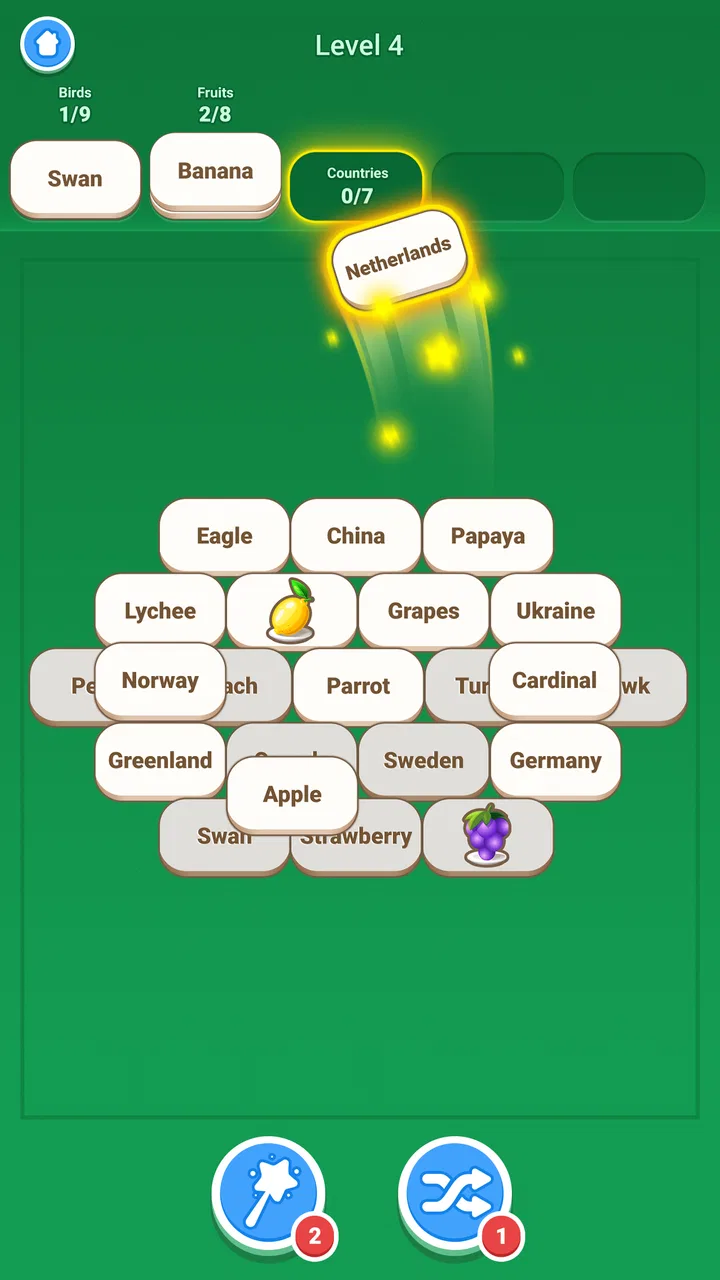
Word Tiles - Word Puzzle Game caught my attention because it takes a familiar word-game idea and presents it as a small exercise in connection and logic. Instead of asking me to build long words from loose letters, it asks me to look at a group of words and decide which ones belong together. That change sounds simple, but it creates a different kind of concentration: I am not only searching for vocabulary, I am testing relationships, spotting misleading links, and deciding which interpretation is strongest.
After spending time with it, I see this as a quiet, focused game for short sessions rather than a loud, feature-heavy mobile experience. Hypervation keeps the central task easy to understand, which makes the game approachable from the first puzzle. The free price also removes the biggest barrier to trying it. With an Everyone age rating and support for Android 6.0 or later, it is positioned as an accessible choice for casual players, families, and anyone who enjoys word challenges without needing a complicated tutorial.
The first impression is helped by the compact idea behind the game. The store short description calls it “Word Tiles,” and that is a useful way to picture the interaction: words are presented as pieces that need to be arranged mentally into meaningful groups. The broader goal is to master connections between words, so each round feels less like a spelling test and more like a small logic investigation.
You May Also Like

 Pandora - Music & Podcasts
Pandora’s Music Is Easy to Start, but Harder to Recover
Pandora’s strength is its low-effort path from a seed to a station. Its weak spot is how much confidence it asks you to place in connection, setup, and quiet recovery.

 AccuWeather: Weather Radar
AccuWeather Review: A Quick, Clear Forecast for Everyday Decisions
For everyday plans, the best forecast is the one you can understand quickly. AccuWeather makes rain timing, radar, and local conditions easy to act on, with a few trade-offs.

 Hill Climb Racing
Why Hill Climb Racing Still Turns Crashes Into One More Run
A tiny car, a bumpy hill and one more upgrade: Hill Climb Racing keeps resurfacing because its simple chaos makes every near-miss feel personal.

 AliExpress - Shopping App
AliExpress Makes Global Shopping Feel Personal, but Shoppers Bear the Risk
AliExpress turns a global marketplace into a pocket-sized discovery engine. Its reach is useful, its shopping loop compelling, and its trade-offs easy to miss.

 Lords Mobile: Kingdom Wars
Lords Mobile Is a Kingdom-Building Routine, Not a Quick Match
A case-by-case verdict on the building, battles, device demands, and social commitments that make Lords Mobile rewarding for some players and exhausting for others.

 PDF Scanner app - TapScanner
TapScanner Makes Paperwork Easier to Capture, Check, and Share
TapScanner makes scanning with a phone feel less like a rescue operation and more like a dependable step in getting work done. Its capture tools are useful, though not flawless.
More From Our News Desk
View All News


How the game turns word recognition into a calm logic challenge
I find the appeal of Word Tiles in the moment when a loose collection of words starts to look like a set of deliberate clues. That makes each puzzle feel less like a vocabulary quiz and more like a small investigation: I compare meanings, test a possible connection, and see whether it helps the whole board make sense. That focused style is also the best way to judge where the game’s simple premise succeeds—and where its ambiguity can ask for patience.
The first few puzzles establish the right kind of attention
What I like most about the opening experience is that the premise does not need much explanation. I can begin by reading the available words, searching for possible categories, and checking whether the remaining pieces support or weaken my first idea. That immediate readability matters in a mobile word game. I do not want to spend the first session learning a complicated interface before reaching the actual puzzle.
The challenge comes from ambiguity. A word can often fit more than one possible group, especially when the connection is based on meaning rather than spelling. That makes every selection a small commitment. I have to ask whether I am seeing a genuine category or merely noticing a loose association. This is where the game becomes more thoughtful than a basic matching exercise.
My best advice for new players is to avoid locking onto the first attractive group. Read every tile before making a choice, then look for words that seem unusually specific. A broad connection may be a distraction, while a narrower relationship can reveal the intended structure of the puzzle. This habit is useful because it turns guessing into a repeatable process: scan, propose, test, and reconsider.
A practical game for small gaps in the day
I can easily imagine playing during a coffee break, on public transport, or while waiting for an appointment. The format suits moments when I want something more engaging than scrolling but less demanding than a long strategy game. A single puzzle can receive my full attention without requiring me to remember a complex story, manage a character, or return at a precise time.
That convenience also makes it suitable for sharing with another person. Two players can look at the same word set and argue about whether a category is valid. In that situation, the game becomes a conversation starter as much as a solo challenge. It is especially enjoyable when one person notices a connection that the other completely missed, because the discussion exposes how differently people organize language.
There is a useful trade-off here. The game’s focused structure makes it easy to pick up, but players who want a large world, character progression, or a strong long-term narrative will not find those elements at the center of this experience. Its appeal depends on whether the act of sorting ideas is enough to keep you coming back.
The visual language supports the puzzle rather than competing with it
The art direction works best when it keeps attention on the words. For this type of game, visual decoration should create a pleasant setting without making the tiles harder to read. A clean presentation helps me compare possibilities quickly, and that clarity is more valuable than elaborate effects. The visual mood feels suited to a logic puzzle: contained, orderly, and calm enough for careful thought.
That restraint is important because word games can become tiring when the interface constantly demands attention. I prefer a design that lets the category-solving task provide the drama. The tiles themselves are the meaningful objects, so the visual identity succeeds when it gives them enough presence to feel like pieces of a puzzle while leaving the language in control.
One non-obvious strength of this approach is that it makes mistakes informative. When a proposed group fails, the screen remains conceptually simple. I can return to the remaining words and examine them without having to process a busy animation or a separate layer of game systems. The failed attempt becomes part of the reasoning rather than a disruption.
The setting is created through order and association
Word Tiles does not need a conventional fantasy map or a detailed fictional setting to establish a sense of place. Its world is built from language itself. Each puzzle creates a temporary landscape of meanings, and the categories become the landmarks. As I solve one relationship, the remaining tiles change character, almost as if the puzzle is revealing its shape one section at a time.
That setting is modest, but it is coherent. The game’s atmosphere comes from the transition between confusion and clarity. At the beginning, the board feels crowded with possibilities. After one secure connection is found, the rest becomes easier to interpret. This gives the experience a gentle rhythm of uncertainty, discovery, and confirmation.
I find this more satisfying than a purely visual matching game because the important movement happens in my head. The tiles may stay in place, but my understanding of them changes. A word that seemed unrelated can suddenly become obvious once another category has been removed. The game’s world language is therefore semantic: it asks me to travel through meanings rather than through locations.
Sound and rhythm should remain in the background
The strongest mood for this kind of puzzle is quiet concentration. Sound works best when it supports a decision, a successful group, or the completion of a round without becoming the main event. I approach Word Tiles as a game I can play while relaxing, so I value an audio rhythm that leaves room for thought rather than pushing me toward hurried actions.
That pacing also affects how I judge the game mechanically. A word-connection puzzle needs enough time for reflection. If every move feels rushed, the experience becomes a test of speed instead of a test of reasoning. Here, the basic concept naturally encourages a slower tempo: read, compare, doubt, and then commit. The result is closer to solving a compact brainteaser than chasing a high-adrenaline score.
For players who normally choose action games, this may initially feel almost too restrained. I would not recommend it as a replacement for a fast arcade session. I would recommend it when the goal is to reset mentally, focus on one problem, and enjoy the small satisfaction of seeing a confusing set of words become organized.
Why the pacing makes short sessions feel complete
The game’s pacing is one of its most convincing qualities because the core loop has a natural beginning and end. I start with a messy collection of possible relationships, work through uncertainty, and finish when the categories make sense. That structure gives even a brief session a feeling of completion, which is useful on a phone where interruptions are common.
A realistic example is an evening when I have ten quiet minutes but do not want to begin a larger game. I can open the puzzle, examine the words, and stop after reaching a solution without feeling that I have abandoned a campaign. If I am interrupted, the mental problem is also easy to resume because the board itself reminds me what I was considering.
The limitation is that players who need constant novelty may find the loop repetitive. The pleasure comes from the quality of the connections, not from dramatic changes in controls or setting. If sorting words into categories does not appeal to you, a more conventional word search or a crossword app may offer a better sense of variety.
The mechanics reward elimination more than quick guessing
The central mechanic fits the game’s mood because every tile has two roles: it can support a category, or it can help disprove one. I get better results when I treat the board as a system of constraints. Once a group is confirmed, the remaining words become easier to evaluate. This is more reliable than selecting the first four words that appear related.
One useful technique is to begin with the most concrete connection, but not necessarily the largest one. If several words clearly describe the same object type, activity, or familiar expression, that group may provide a stable starting point. After removing that mental possibility, I can inspect the ambiguous words with less noise. The game rewards this kind of disciplined narrowing.
Another practical tip is to watch for category overlap. A word may fit a broad theme while belonging more precisely to a different group. When that happens, I ask which interpretation leaves the rest of the board most coherent. This is the key difference between a lucky guess and a reasoned solution: the correct group should improve the entire puzzle, not merely explain a few tiles.
That design gives the game genuine replay value at the level of thinking, even though the interaction remains simple. I am not replaying because the controls change; I am replaying because I want to improve how I read relationships. It is a good fit for people who enjoy lateral thinking and language puzzles, especially those who like finding a hidden structure inside ordinary words.
Where the experience may frustrate players
The same ambiguity that makes the puzzles interesting can also create friction. When multiple categories seem plausible, a wrong move may feel less like a failure of logic and more like a disagreement about interpretation. That is not necessarily a flaw, but it means the game depends heavily on clear category construction. Players who prefer one unquestionably correct answer may become impatient with the gray areas.
I also would not choose this game for vocabulary practice in a strict educational sense. It encourages flexible associations, but that is different from teaching definitions, spelling rules, or a structured language curriculum. Someone learning a new language may enjoy it as a light supplement, yet a dedicated vocabulary tool would be more useful for systematic study.
The current version is 0.1.0, which places the game at an early stage of its development. I treat that as a reason to keep expectations focused on the central puzzle experience rather than expecting the breadth of a mature word-game platform. The main question for a potential player is simple: does the existing connection mechanic already sound enjoyable enough to justify trying it?
How it compares with familiar word-game alternatives
Compared with a crossword, Word Tiles feels less dependent on recalling a specific answer from a clue. A crossword usually guides me through intersecting entries, while this game asks me to discover relationships among visible words. That makes it more approachable when I want a logic task without committing to a large grid.
Compared with a word search, it is less about scanning for letter patterns and more about interpreting meaning. A word search can be relaxing because the target is known; here, I often need to decide what the target category should be. Players who enjoy semantic puzzles will likely prefer this extra layer, while players who want a straightforward visual hunt may find it unnecessarily uncertain.
Compared with a spelling or anagram game, the emphasis is also different. I am not primarily competing against a timer or trying to form the longest word. The experience is more deliberate, and that makes it a better match for quiet play. On the other hand, anyone seeking rapid rounds, score chasing, or competitive pressure may find a timed alternative more energizing.
In my view, the game occupies a useful middle ground between casual word play and logic puzzles. It is accessible enough for a quick try, but the strongest solutions require more than recognizing familiar vocabulary. The trade-off is that its appeal is narrow by design: the better I enjoy categorization and ambiguity, the more likely I am to appreciate it.
Who should try it and who should skip it
I would recommend it to players who like arranging information, noticing hidden links, and solving problems at their own pace. It also suits people who want a free mobile game that can be played in short bursts without requiring a large time commitment. Families may enjoy comparing answers, although younger players may need help with unfamiliar words or less obvious relationships.
The Everyone rating makes the concept broadly approachable, but age suitability does not guarantee equal difficulty for every player. A child can understand the objective while still finding certain categories challenging. Adults who enjoy language games may appreciate that the challenge comes from interpretation rather than from complex controls.
I would skip it if my priority were a story-driven adventure, a social competition, or a rich progression system. I would also look elsewhere if I wanted formal vocabulary lessons, detailed performance analysis, or the familiar clue-and-grid structure of a traditional crossword. This is a focused puzzle game, and its simplicity is both its identity and its boundary.
Availability and everyday practicality
The game is free to try, which makes the decision easy for curious players. It has reached over ten thousand installs and holds a 4.2 average from around twenty-five ratings, so there is already a small group of players responding positively to the concept. I would read those figures as encouraging but still early, rather than as proof that it will suit everyone.
Hypervation is the developer behind the game, and the modest version number reinforces the impression of a young project. On a compatible Android device, the minimum requirement of Android 6.0 or later keeps the technical entry point relatively broad. That is helpful for people using an older phone who want a lightweight word puzzle rather than a demanding visual game.
Before installing, I would think about the kind of attention I want from my next mobile game. If I want something I can open, understand, and play without learning a large ruleset, this is a sensible candidate. If I need a deep content ecosystem immediately, I would choose a more established alternative with a wider range of modes.
The atmosphere verdict
My overall impression is that Word Tiles succeeds when it keeps its art direction, setting, sound, and pacing aligned with the act of thinking. The game does not need spectacle to create a mood. Its atmosphere grows from the calm presentation of words, the gradual reveal of relationships, and the small moment when a scattered board finally makes sense.
The mechanics remain the reason to stay. The visual and audio choices matter because they protect the concentration needed to solve the categories, not because they distract from them. That coherence gives the game a distinct personality: it feels like a quiet desk puzzle adapted for a phone, with enough ambiguity to make each decision meaningful.
My recommendation is straightforward: try it if the pleasure of finding connections is more important to you than speed, story, or spectacle. I would gladly keep it installed for short thinking breaks, especially when I want a game that feels mentally active without becoming stressful. Its early-stage presentation and focused loop may limit its audience, but for the right player, that focus is exactly what makes it worthwhile.
FAQs for Word Tiles - Word Puzzle Game
01What is the objective of Word Tiles - Word Puzzle Game?
Word Tiles - Word Puzzle Game is designed to challenge players’ vocabulary and problem-solving skills. The objective is to form words by connecting letters on the game board. Each level presents a unique puzzle where players must discover all the hidden words to progress, enhancing their language skills along the way.
02Is Word Tiles suitable for all age groups?
Yes, Word Tiles is appropriate for players of all ages. The game features varying levels of difficulty, making it accessible for children, teenagers, and adults. Its educational aspect also makes it a great tool for younger players to improve their vocabulary and spelling skills in an engaging way.
03Does the game require an internet connection to play?
Word Tiles can be played offline, which makes it a convenient option for users who want to play without being connected to the internet. However, certain features, such as leaderboards and in-app purchases, may require an internet connection to function properly.
04Are there in-app purchases available in Word Tiles?
Yes, Word Tiles offers in-app purchases that enhance the gaming experience. Players can buy additional hints or remove ads for a smoother gameplay experience. While the game is free to download, these optional purchases can help players progress more easily through challenging levels.
05How does Word Tiles enhance language skills?
Word Tiles helps enhance language skills by encouraging players to form words from a random assortment of letters. This process aids in expanding vocabulary, improving spelling, and developing problem-solving abilities. The game’s progressive difficulty levels also ensure that players are continually challenged and learning.
Pros
- Engaging puzzles enhance vocabulary.
- Intuitive controls for easy navigation.
- Visually appealing graphics.
- Offline play available.
- Regular updates with new levels.
Cons
- Ads can be frequent and intrusive.
- Limited hints can slow progress.
- In-app purchases can be pricey.
- May become repetitive over time.
- No multiplayer option available.

Word Tiles - Word Puzzle Game
Gallery